
Labor Transport Planning Guide
Professional Saudi transport guidance for workforce route planning, with practical checks for camp gate, project gate and worker shift timing, vehicle choice, timing and quote preparation.
Labor transport planning needs camp location, site gate, worker count, shift schedule and AC or non-AC requirement. The route should be written for real site movement, not only as a request for a large bus.
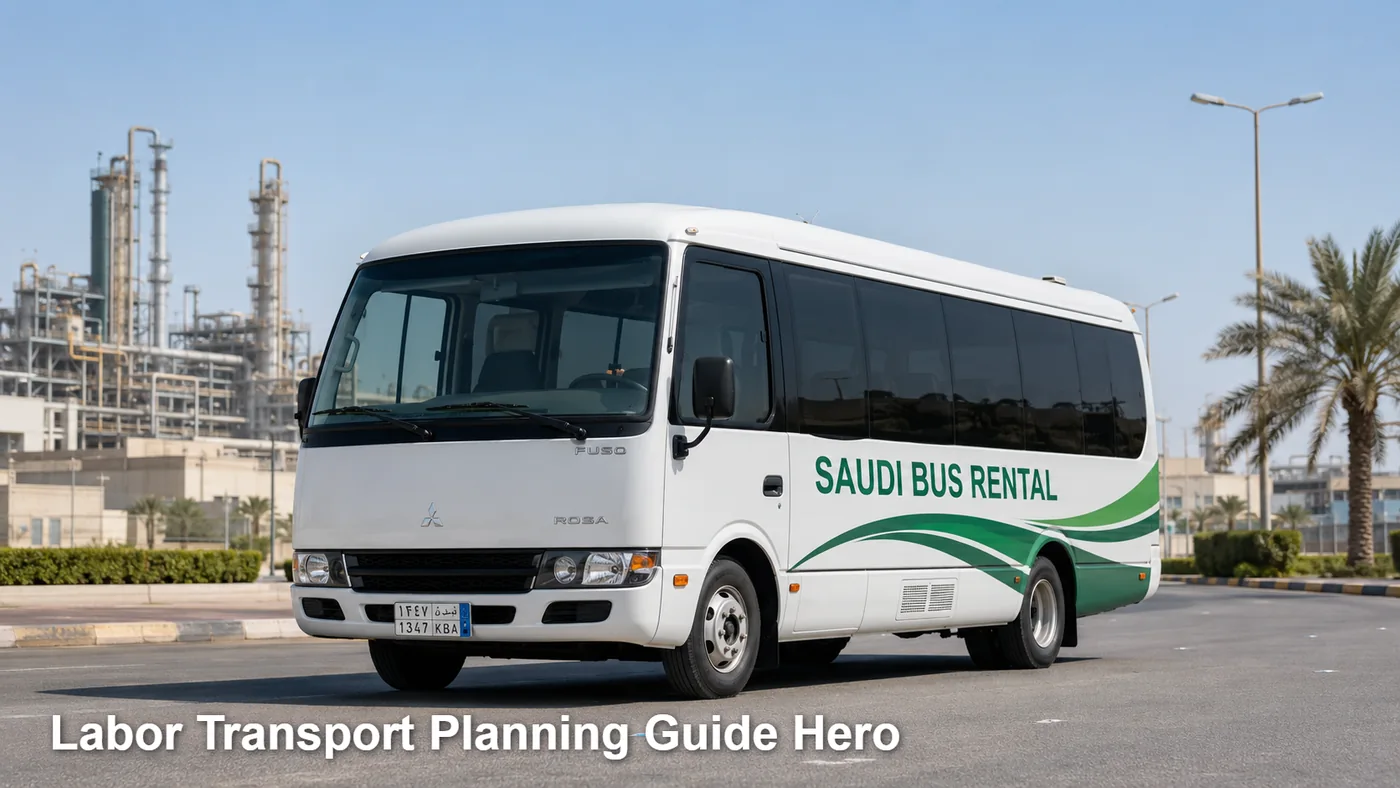
Workforce Route Planning quick answer
For workforce route planning, start by confirming camp gate, project gate and worker shift timing. Then add worker count, AC requirement, site access note and supervisor contact. This gives Saudi Bus Rental enough context to review the request as a real movement, not a vague enquiry.
The page helps a camp, project or construction coordinator decide which bus capacity and operating window can support the workforce. It also shows the mistakes that can delay pricing, dispatch or approval.
- Confirm camp and site points
- List worker movement times
- Set passenger capacity
- Check site requirements
- Choose bus category
- Submit for quotation
Decision factors for workforce route planning
Use these workforce route planning factors to check whether the route, vehicle expectation and approval path are ready for a serious quote request.
Camp pickup
The camp gate, waiting area and worker assembly process affect departure timing.
Site access
Project gates may need vehicle details, driver information or advance coordination.
Worker count
A normal count and peak count help avoid capacity shortage.
Shift pattern
Day shift, night shift and split shift routes should be planned separately.
Bus type
AC, non-AC and high-capacity buses should be chosen according to project requirement.
Safety instructions
Workers should know pickup time, boarding point and return process.
Backup planning
High-volume routes need a clear response when a bus is delayed or unavailable.
Contract scope
Daily, weekly and monthly project transport require different commercial terms.
Steps for preparing workforce route planning
Follow these steps before sending the workforce route planning requirement to sales or operations.
Confirm camp and site points
Write the exact camp pickup and project gate details.
List worker movement times
Separate reporting and return times for every shift.
Set passenger capacity
Give normal and maximum worker counts, including supervisors if they travel.
Check site requirements
Add gate pass, induction, route restriction or waiting notes.
Choose bus category
Match AC/non-AC and capacity to route duration and project instruction.
Submit for quotation
Send the full worker movement plan for availability and pricing review.
Using workforce route planning in a real enquiry
A labor route can be delayed by gate checks, worker boarding discipline or late shift changes. When the camp, gate, worker count and timing are written clearly, the transport provider can plan the correct bus and driver window more confidently.
How labor transport planning guide helps the first decision
workforce route planning is useful because it turns a broad transport question into a short list of facts that a buyer can act on. The visitor should leave knowing what to count, what to measure, which timing details matter and when a route is ready for quote review. For construction companies, industrial sites, camp coordinators and project teams moving workers between accommodation and site, the value is not a long theory. The value is a cleaner request that reduces delays, repeated questions and wrong vehicle selection.
What to decide before sending for workforce route planning
Before contacting Saudi Bus Rental, the buyer should decide the minimum practical details for this topic: the movement type, the timing, the capacity requirement, the route or site information and the person who can approve changes. With workforce route planning, a clear enquiry also protects the visitor from comparing services that are not equal. A request with route, people, luggage and timing is easier to review than a one-line question.
Where guidance stops for workforce route planning
For workforce route planning, the guidance is preparation, not a final contract, live availability confirmation or regulatory approval. When the movement involves safety, school passengers, project access, machinery or contract terms, the buyer should confirm the details in writing before dispatch or service confirmation.
Mistakes to avoid in workforce route planning
These workforce route planning checks reduce wrong pricing, wrong vehicle choice and last-minute service confusion.
Ignoring gate access
A bus can arrive on time but still wait if the site gate process is not ready.
Quoting from rough headcount
Understated worker numbers can create capacity and safety issues.
Combining shifts casually
Each shift needs its own movement time and route instruction.
How to hand over workforce route planning clearly
A clean handover for workforce route planning gives the sales and operations team enough information to review the request without guessing. Keep the details in one message and show which points are fixed, which points may still change and who can approve the final answer.
Fixed details check for workforce route planning
For workforce route planning, the fixed details are usually camp gate, site reporting and the date or operating window. These items should not be left for later because they decide whether the transport request is ready for pricing or still needs internal review.
Flexible details check for workforce route planning
Some details may still move, such as worker count, ac requirement or small timing changes. Mark them clearly as estimates so the quotation is not treated as final when the requirement is still changing.
Approval contact check for workforce route planning
The approval contact for workforce route planning should be able to confirm route changes, timing changes, payment questions and service-day instructions. Without one responsible contact, the driver, passengers and sales team may receive mixed directions.
Planning versus confirmation for workforce route planning
General guidance helps the buyer prepare, but confirmation for workforce route planning still depends on real availability, route review and written approval. Treat the guide as preparation, then use the quote path when the scope is ready.
Service-day risk review for workforce route planning
Check the points most likely to cause delays: shift changes, contact response time and last-minute passenger or load changes. A short review before dispatch prevents many avoidable complaints.
Complete brief review for workforce route planning
The final brief for workforce route planning should include route, time, quantity, vehicle expectation, special notes and the responsible person. A complete brief is easier to review than several small messages sent by different people.
Final readiness review for workforce route planning
Before a buyer sends workforce route planning for review, the requirement should be checked against the details that most often change the response.
Operational readiness for workforce route planning
Check whether camp gate, site reporting and worker count are fixed or still moving. A transport provider can usually guide the next step faster when the buyer separates confirmed facts from estimates. This also helps avoid a quote that looks complete but later needs revision.
Commercial readiness for workforce route planning
Review whether the rate request, payment path and approval contact are clear. If AC requirement, shift changes or project coordinator could affect cost, mention it before asking for a final number. Commercial readiness means the quotation can match the real service scope.
Service-day readiness for workforce route planning
For workforce route planning, think through what happens on the actual service day. The driver, passengers, site contact or receiving team should understand timing, location and responsibility. This short check turns the guide into an operational handover instead of leaving the final movement unclear.
Quote questions about workforce route planning
These answers cover the most common workforce route planning questions before the buyer moves to quotation or service review.
What details are needed for labor transport?
Send camp location, site gate, worker count, shift timing, bus type requirement and project coordinator contact.
Can labor transport include multiple shifts?
Yes, but each shift should be planned separately so vehicle and driver duty can be checked.
Does AC requirement affect the quote?
It can affect vehicle category and availability, so it should be mentioned early.
What causes most labor route confusion?
Late workers, unclear gate access, changing shifts and missing coordinator details are common causes.
Decision check before confirming workforce route planning
Use this decision check before the request is treated as ready. It helps the buyer separate planning, quotation and service-day control for workforce route planning.
Details to fix first for workforce route planning
Before asking for a final answer, fix camp gate, project gate and worker shift timing. These details decide whether the provider can check a suitable vehicle and realistic service window.
Details that may remain flexible for workforce route planning
For workforce route planning, items such as passenger changes, waiting time or route adjustments can remain flexible only when they are clearly marked as estimates and approved before confirmation.
Proof that helps review for workforce route planning
Useful proof for workforce route planning includes worker count, AC requirement, site access note and supervisor contact. It gives the operations team the information needed to avoid guesswork.
Approval delay risk for workforce route planning
The main delay risk is understated headcount or unclear gate access. Raise this point early so pricing, vehicle selection and dispatch instructions stay aligned.
Next guides after workforce route planning
Choose the related option that fits the next decision after workforce route planning.
Staff Transport Planning Guide for workforce route planning
Use Staff Transport Planning Guide if workforce route planning raises a more specific question about route, price, vehicle, safety or confirmation.
Staff Transport Planning GuideMonthly Transport Guide for workforce route planning
Use Monthly Transport Guide if workforce route planning raises a more specific question about route, price, vehicle, safety or confirmation.
Monthly Transport GuideSafety Checklist Guide for workforce route planning
Use Safety Checklist Guide if workforce route planning raises a more specific question about route, price, vehicle, safety or confirmation.
Safety Checklist GuideRoute Planning Guide for workforce route planning
Use Route Planning Guide if workforce route planning raises a more specific question about route, price, vehicle, safety or confirmation.
Route Planning GuideBus Capacity Guide for workforce route planning
Use Bus Capacity Guide if workforce route planning raises a more specific question about route, price, vehicle, safety or confirmation.
Bus Capacity GuideQuote request path for workforce route planning
Use Request a Quote if workforce route planning raises a more specific question about route, price, vehicle, safety or confirmation.
Request a QuoteSales contact path for workforce route planning
Use Contact Saudi Bus Rental if workforce route planning raises a more specific question about route, price, vehicle, safety or confirmation.
Contact Saudi Bus RentalSend a complete workforce route planning request
Share the route, date, timing, passenger or load details, luggage or item notes, preferred vehicle class and one responsible contact. Saudi Bus Rental can review workforce route planning against real availability, route scope and service-day requirements.
Worker transport often depends on access discipline and shift control more than the map distance alone.
Workforce Route Planning planning detail 9
A final review becomes faster when workforce route planning is supported by one complete message. Include the route, service date, reporting time, return timing, passenger or load details, luggage or item notes, preferred vehicle class and one responsible contact. This keeps the enquiry practical and prevents the first reply from becoming a list of missing questions.